VOLT EV ЖК
Provide residents with convenient EV charging right in the courtyard
VOLT Residential Complex Software-Hardware Complex
The VOLT Residential Complex software-hardware complex is located in a technical room and provides centralized management of charging stations.
Communication with charging stations is carried out via local Ethernet segment or Wi-Fi.
VOLT EV Residential Complex Capabilities
Up to 100 Charging Stations
Cluster power management support for up to 100 charging stations.
Any Manufacturers in One Cluster
Management of charging stations from different manufacturers, including the ability to combine stations from various vendors into a single cluster.
Standalone Compact Device
Delivered as a standalone compact device with pre-installed software.
Protection Against Unauthorized Charging
RFID card authorization. Prevents charging on a neighbor's station and other unauthorized sessions.
Automatic Setup on First Connection
Automatic charging station configuration on first network connection (for charging stations from specific manufacturers).
Smart Meter Readings
Ability to receive current power consumption readings from smart meters of various manufacturers — both domestic and foreign.
API for Residential Complex IT Systems
API for integration with residential complex IT systems and the management company mobile application (option).
Centralized Data Transmission
Ability to centrally transmit electricity consumption data to the management company's IT system (option).
One Station — Multiple Residents
Ability to organize shared use of one charging station by multiple residents with separate electricity consumption accounting.
Типовая схема подключения
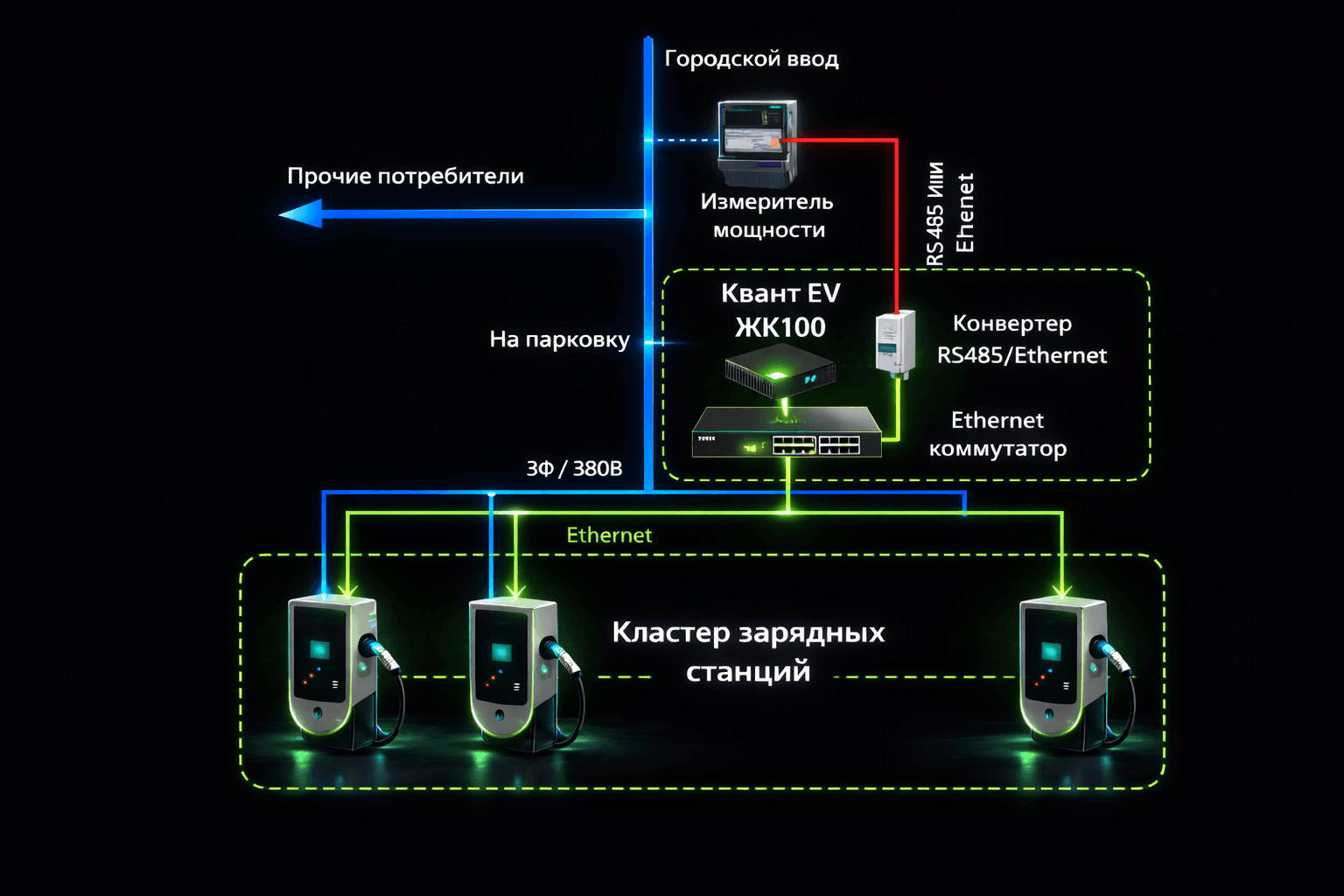
VOLT EV Residential Complex Technical Specifications
Limitations and Precautions
When connecting new charging stations to the management cluster (especially when a station is purchased directly by a parking space owner), ensure they meet the requirements listed below. Connecting a charging station without power management capability may cause incorrect operation of the entire cluster and trigger emergency protection.
The charging station must have a network interface for Ethernet connection (preferred) or WiFi (if WiFi coverage is available).
The charging station must support management via OCPP 1.6J or OCPP 2.0 protocol.
The charging station must support the SmartCharging power management profile.
When connecting a charging station, protection against electric shock must be provided using an RCD (Type A or B). Some charging stations have built-in RCDs; for those that do not, the RCD must be placed in a separate cabinet next to the charging station.
24/7 Technical Support
Real-time system monitoring
lines of support
24/7 Call Center
Will answer all questions and help you charge
Available via phone, WhatsApp, and Telegram
Remote Technical Assistance
90% of all station problems can be solved remotely
Field Technician Visit
If necessary, our specialist will visit the site